


Last month, I challenged myself to write a poem every day, and by the end, I successfully wrote 31.
I learned a few things:
While I had fun, I can’t write poetry worth a lick
Sometimes, by the end of the day, I need to write something, so I cranked out a short piece and emailed it to myself
I’m capable of setting an easy, attainable, educational goal
I’ve never formally studied poetry, so my confidence in writing well-crafted poems is not particularly high. But a lack of confidence has never been a deterrent – I have written poems on and off for decades and have submitted a few into the abyss of magazines and competitions, never to be heard about again.
I spent some time reading poetry and numerous books about it. A few are recent purchases, while others have been sitting on my shelves for years. I’m currently rereading Poetry for Dummies – the perfect book for me.
Inspiration for my December poetry project varied. I found a few that I enjoyed, so I used them as guides to see if I could write something similar without coming across as a plagiarist. Most were about topics or feelings that I wanted to explore and write in various ways. I’ve now collected all the poems and haikus I have jotted down in multiple notebooks and put them in an obnoxiously large notebook so I can continue writing.
Poetry is this majestic, creative art form that I have been drawn to for a long time. I think one trait is that it can use fewer words, and while I can be long-winded, getting to the point in an artistic piece is appealing. On the other end, poetry can be frustratingly complicated – more often than not, when I finish a poem, I’m immediately off to look up words and sit with the idea that I am a dummy.
Regardless of my reactions to any given poem, the allure of poetry will never cease.
Having said all that, I didn’t anticipate that my poetry writing in December would help with my mental health regarding the significant events in the first week of January.
January 7, 2026, will be a memorable day for me in many ways. First, I turned 50. Spending it with my wife was special, and I’m grateful in many ways as I move into the fifth decade of my life.
But I can’t help but think about what else happened on that day, across the world, as it relates to me, my faith, and my citizenship.
In Rome, Pope Leo XIV, the only American Pope in the history of the Catholic Church, effectively began his pontificate. Even though he was elected back in May, Leo spent the rest of 2025 fulfilling his predecessor’s work as the Year of Jubilee came to an end. On January 7, he summoned the 170 world’s Cardinals back to Rome to spend the next two days discussing how the Church was going to lead.
To put it simply, Leo wants a continuation of Pope Francis’s vision of a mission-oriented Church that implements the reforms of the Second Vatican Council, which is over 60 years old now and remains to be a point of contention within pockets of the Church over ideas like “Should the Mass be said in Latin rather than English,” even though Jesus spoke neither.
These are important arguments for some reason.
Leo wants regular conversations on how the past can move the Church forward. He leads with moral clarity, patience, and inclusion.
Hours later and thousands of miles west of Rome, tragedy struck. In an all too familiar situation in the United States, this time on the southside of Minneapolis, Minnesota, parents rushed to their children’s school upon word spreading that someone nearby had been shot. After accounting for their kids and relishing the emotions that they were safe, parents and soon the rest of the world discovered that the US Immigration and Customs Enforcement officer shot and killed Renee Good, a mother of three, who had earlier dropped off her six-year-old son at school.
In what felt like minutes after news spread of the deadly encounter, the vice president of the United States, JD Vance, took to the White House briefing room to condemn Good and justify the actions of the ICE officer with outrageous claims that her killing was justified. Vance, a converted Catholic since 2019, claimed that Good, who had her geriatric dog in the backseat of her Honda Pilot and a glovebox full of stuffed toys, was a “leftist agitator” and had been radicalized into being a “domestic terrorist.”
For the past ten days, the Trump administration and its Republican allies in Congress and media sycophants have been aggressively and consistently pushing this narrative. Vance, in particular, as someone who believes that Jesus Christ, God’s only Begotten Son, was murdered by the hand of the Roman state, with impunity, asserts that a mother deserved to be shot in the face multiple times, denied medical attention, and remembered as a terrible person.
Vance wants to shut down any conversation about the matter and govern with cruelty as a policy.
Just like George Floyd, Breanna Taylor, and Trayvon Martin, I didn’t know who Renee Good was before she was executed on a public street. But when I read more about her life, I learned that Good was a poet. That she studied and practiced it. She was the 2020 Academy of American Poets Prize winner at Old Dominion University for her “On Learning to Dissect Fetal Pigs,” which a judge of the competition described as a struggle between faith and science. He remarked that Good asked the question: “What does it mean to define something until there is no wonder left?”
I’ve read Renee’s poem a few times. I’m still navigating what it means to me, but that’s what poetry is supposed to do to you. Poetry is something you can come back to, especially after you reread the chapter in Poetry for Dummies about how to read poetry more effectively.
There’s a power in poetry that I didn’t fully appreciate until this past week. I had no ambitious motives to write my December poem a day; it’s just something I wanted to do. When I sped through a few of them, I was reminded that the intention wasn’t to simply complete them, but to dig deeper into the process. I needed to slow down and connect to something more profound.
Poetry connects all of us, whether you know it or not. Poetry ties me, Pope Leo, and Renee Good together. In his December blessing, Leo cited a short passage of an Israeli poet, Yehuda Amichai, called Wildpeace.
Poetry is a literary work that many Popes have used. They understood how its syntax can soar into readers’ minds and hearts. Pope Leo XIII was a prolific poet, having penned numerous poems. Pope Francis used to teach literature, and when he became the Holy Father, he called on poets to help us dream. St. John Paul II published a book of poems in 2003 that I purchased immediately, and now can’t find. JPII attended the Second Vatican Council in 1962 and, before it began, wrote a poem titled “Marble Floor.”
Renee Good and the Popes agree that poetry has many positive effects. I found this study supporting the claim that poetry during the COVID-19 pandemic brought “inspiration, solace, and triumphs in the face of adversities.” If you take the time, you can find many other studies and articles that say the same thing – poetry is good for everyone, especially dummies.
While the College of Cardinals argues over rules and practices they agreed to decades earlier, Americans debate the narrative of Renee Good’s death. We continue this silly practice just like with January 6, 2021. What you can see on video is supposedly not what you see on video, according to the Catholic vice president, whose faith is rooted in not seeing your Savior with your own eyes.
When he converted to Catholicism, Vance wrote of his attraction to a “majestic” Jesus that he never experienced before. On January 7, 2026, he willfully ignored that feeling as he gaslighted the world with an invented narrative of righteous anger in support of a murderer. He even callously described Renee in minimalist terms: “Look, I don’t know what is in a person’s heart or in a person’s head.”
We do. We have her poems.
This is the hopeful power of poetry. Words written down and shared to express what it means to be human. In the space between each word lies the majestic hope of a better life if we just slow down and dig deeper. We know people and their dreams by their words and deeds.
As Leo begins his leadership of the Catholic Church by using the past as a guide, Vice President Vance and others want to drag us back to a past, erasing all the progress we have made in overcoming it.
All of this is overwhelming. Renee Good reminded me that we have poetry to help us.
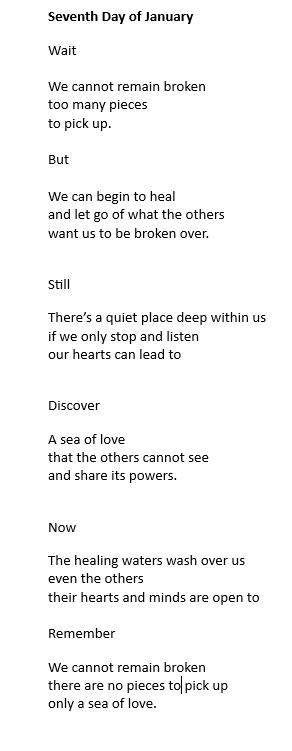
Here’s my poem for you.
My instant reaction haikus:
Thank you, Christopher / I too find solace in poems / They ground and expand us all
Poetry is good / Sad to say but Renee Good / Was and is no more
Poet Renee Good / Was terminated by ICE / All but MAGAts grieve
Now I want to learn more about poetry! Thanks Chris.