Jon Fasman is the senior culture correspondent for The Economist. One bio I read also lists him as a podcaster, investigative journalist, and novelist with two completed books, including a New York Times Bestseller, which hasn’t been well-received on Goodreads. Jon was born in Chicago, grew up in Washington, DC, and attended Brown University with a degree in History and English, making him likely to be an excellent barista if the Economist gig ever ended.
Fasman might be taking your latte order soon, because back in October, he cobbled together an essay on Johnny Cash, this time for the Wall Street Journal, with a peculiar take about how the singer was now getting his due as a culture icon.
As wild as that pronouncement is, it’s not the first time this idea about Johnny Cash has come to my attention.
Jason Aldean is a country singer who broke into the national spotlight in 2005 with a self-titled debut album that featured his first number #1 hit “Why,” a song about a guy who spends time asking himself why he treats his lover terribly, but never gets to the answer, and no, it’s not a parody song. Two years later, Aldean released a song titled “Johnny Cash,” the first single from his second album, Relentless, and in this instance, the guy treats his lady so well that he steals her away forever while they listen to Johnny Cash. This song peaked at #6.
When “Johnny Cash” hit the airwaves, I remember the surrounding narrative was that people would learn about Johnny Cash and that he was in the midst of becoming a cultural icon. Never mind that the critically acclaimed movie, Walk the Line, came out in 2005, featuring Reese Witherspoon, who won an Academy Award. For anyone who might have missed the movie, this country music guy was sure going to help thrust Cash into the spotlight.
Fasman, Aldean, and I are all around the same age (heck, so is Reese!). Jason and I grew up on country music, while Jon grew up listening to classic and punk, a combination that sounds about right for someone who ended up at an Ivy League school. The point really is that we are all culturally aware, creative people who would be inclined to know a thing or two about other artists.
What’s funny to me is the idea that someone my age discovering the artist Johnny Cash. I don’t mean to suggest that New York Times Bestseller and future Starbucks Barista of the Year found Cash recently - in the WSJ article, Fasman mentioned buying a Cash CD, which I think was last done in 2012.
But I’m not sure what motivated Fasman to pen an article in the Wall Street Journal about Cash and to reference A Complete Unknown, a movie released last year, other than to point out that also in 2024, his son announced in music class that “Ring of Fire” is his favorite song.
If you’ve been a fan of Okay History for a while, you know how much of a fan I am of Johnny Cash. I wrote about Cash’s performance of “Folsom Prison Blues” in 2022. I posted an essay a year later on the anniversary of his death. “I Walk the Line” is the wedding song for Anonymous and me. I couldn’t resist writing about him again, this time in defense of always being a cultural icon, as we commemorate the release of “Folsom Prison Blues” this week on December 15, 1955.
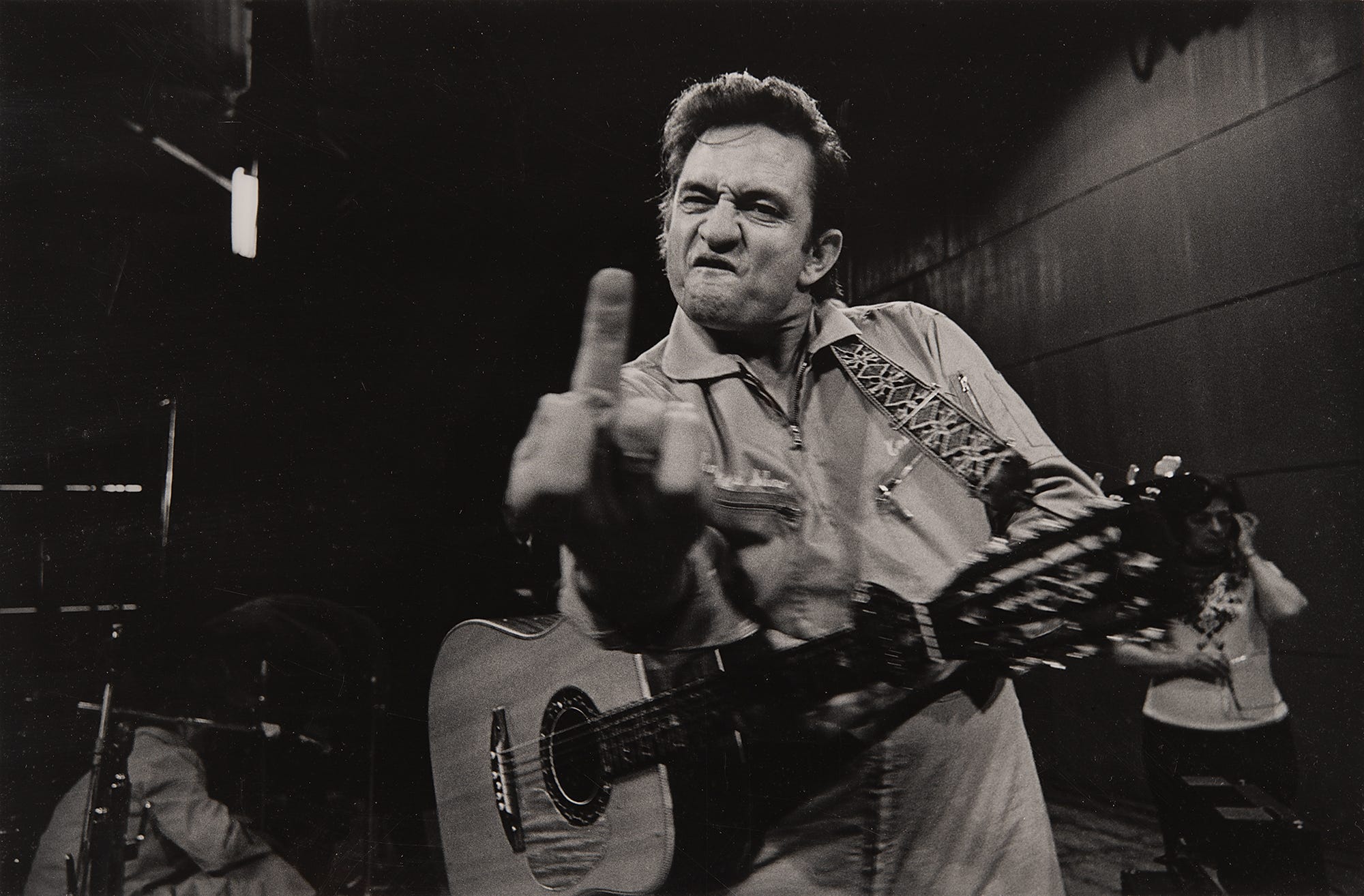
Toward the end of the paywalled piece, Fasman makes the argument that Cash hasn’t been given his due until Fasman Jr. declared it in class, because he lived in a music genre of country music, which is not highly regarded, such as punk. He even oddly suggests that Cash “was never counterculturally cool, and he could seem a little square.”
He’s talking about a guy who made prisoners lose their minds in worship of him when he came and performed for them, mostly unnoticed by the public. Cash even tried to become a prisoner himself and was arrested seven times, once for trying to smuggle about a billion pills in his guitar case from Mexico.
If Cash is a square, then why did he even write “I Walk the Line?” Does Fasman even know what he has discovered?
Anyway, I shouldn’t pile on a guy simply because he came around to learning more about Johnny Cash and the gift he gave the world with his music. In about ten or so more years, we will have another moment when people learn about Cash’s faith and love of his country.
Okay, let’s highlight what else happened this week. As a reminder, these events mark their anniversary, ending in 5 or 0. Here’s what I got:
1. The Thirteenth Amendment to the Constitution was ratified on December 18, 1865. OKH’s #2 Ranked Constitutional Amendment abolished slavery, but left a huge hole for interpretation in terrible ways, which included prison sentences that felt like slavery. 27 states out of 36 needed to ratify, including rebel states we were trying to rejoin the Union. Georgia’s ratification vote came a few weeks earlier, and Secretary of State William Seward made it official. Mississippi and Delaware both voted it down back in February. Mississippi wouldn’t certify it until 2013, which is why it ranks lowest in my view of all the states.
2. South Carolina voted for secession on December 20, 1860. The Palmetto state had always flirted with the idea of breaking itself off from the United States. John C. Calhoun, Andrew Jackson’s Vice President, championed the nullification movement, which argued that states could wave a magic wand and federal laws, like tariffs on goods entering South Carolina, could be wiped away. Over the following two decades, secessionist ideas remained simmering. With the election of Abraham Lincoln, South Carolinans felt their way of life was in danger and held a convention, taking a unanimous vote. South Carolina became the first state to secede from the Union, and the Civil War would begin in April the following year.
3. The United States Senate repeals the “Don’t Ask, Don’t Tell” Policy on December 18, 2010. The military policy prohibited openly gay and lesbian individuals from serving. Passed in 1993, the military would discharge over 10,000 service members for the discovery of their sexual orientation. Barack Obama made repealing the policy an official campaign promise in the 2008 election. The vote for repeal was 65-31. The House of Representatives passed a similar bill the day before.
Usually on the weekends, I tend to sleep in, which for me means waking up at 5:30 instead of 4:45 am. On Saturday, I wandered downstairs a little past 7:00 am, after scrolling Instagram for too long, when, after grabbing my glass of water, I noticed that our tree had fallen over and was lying on the floor.
After politely waking Anonymous, we assessed the situation and, after a few trips to the hardware store, got everything settled. So this year, Anonymous got to put up Christmas decorations on the tree twice, which makes up for not doing it at all last year.

Anonymous will be gone again this week, so instead of thinking I’ll be able to deliver another essay this week, let’s just wait and see how it goes. I don’t think I have any evening events like I did last week, but then again, you never know.
Have a great week. Thank you for your support of Okay History! Appreciate you all. Stay warm!
Okay,
Chris