


In my unexpert opinion, the best hockey is currently being played in Milan, Italy, during the 2026 Winter Olympics. Although I do not consider myself a hockey expert, or even a casual fan.1 I am fortunate to live in a city with a public transit system and a hockey team.2 I feel that elevates your intelligence status3 because you live in an elite international metropolis.
Inhabiting an elite international metropolis, while not being even the slightest enthusiast in any subject, should never stop anyone from making declarative statements, and in turn, from anyone reading them. So here’s my superior, intelligent position on hockey: Olympic hockey is better because it appears to be faster than regular-season games in the National Hockey League.4 Also, one good nuance between the two games is that Olympic hockey also lacks a role typically found on every professional league team – the Enforcer.
The Enforcer has a unique role in sports. Despite its existence, it’s not listed as an official position on any roster list. I can’t think of another sport with a specific player whose job is defined by a single action beyond the simple position.
But to hockey teams, the Enforcer is an essential player because his assignment on the ice is to strike fear and intimidate the opposing team, while at the same time protecting the star player5. The Enforcer can turn a hockey game into a bar brawl.6
“The tough-guy” responsibility evolved over time as teams discovered that, in exchange for penalty minutes racked up by one player, they could increase their win total. The Enforcer role entered its golden era in the 1970s, when championship teams had the “old school goon” who looked like a bouncer and was paid even less, doled out punishment for any reason – to change momentum, for protection, or to draw penalties. They lacked skills such as defending, scoring, and passing.7 Enforcers are characters in the hockey universe and have villainous names like “The Big Dog,” “Tank,” and my personal favorite, “Spicy Tuna.”
What hockey discovered success through brute force, the same can be said of politics.
Politics can easily be described as a “Street Fight.”8 Someone who runs an office or holds an elected position is expected to be a “fighter” or willing to “fight”. In the social media world of the 21st century, demonstrating your toughness is critical to your political success and advancement. In presidential politics, who you choose as your running mate indicates how much you embrace the idea that you need someone to enforce your positions and set the expectations to the voting public that your opponent is hot garbage that should never be elected.
We all understand that during a presidential election, the candidates will let zingers fly and provide the red meat to their base on the campaign trail, but the vice president position has evolved into the Enforcer of the president.
Just as the NHL Philadelphia Flyers were winning Stanley Cups in the 1970s, the term “attack dog” was beginning to take hold as vice presidential lingo. In 1976,9 Pulitzer Prize columnist Mary McGrory described then Republican vice-presidential candidate Bob Dole as an “attack dog” partisan, a person on the ticket who was “a bone thrown to the smoldering right.”
McGrory correctly predicted that Dole and his boss, a former vice president himself, Gerald Ford, would lose that fall election.
Over the past 50 years, the term “attack dog” has stuck. During the last election in 2024, I dreamed of a Vice President Coach, but his attack skills were no match for the Not Rated, name-changing current Vice President, who employs his attack dog mentality to denigrate mothers who were murdered by federal agents.
We can trace the beginnings of the presidential attack-dog-enforcer role even further back. This is where we begin our next round of vice president rankings and the guys who defined their enforcer ways – forever entrenching them as bad vice presidents and showing us that being the goon is politically advantageous, but democratically corrosive.
Let’s Dive in.
50: Richard Nixon
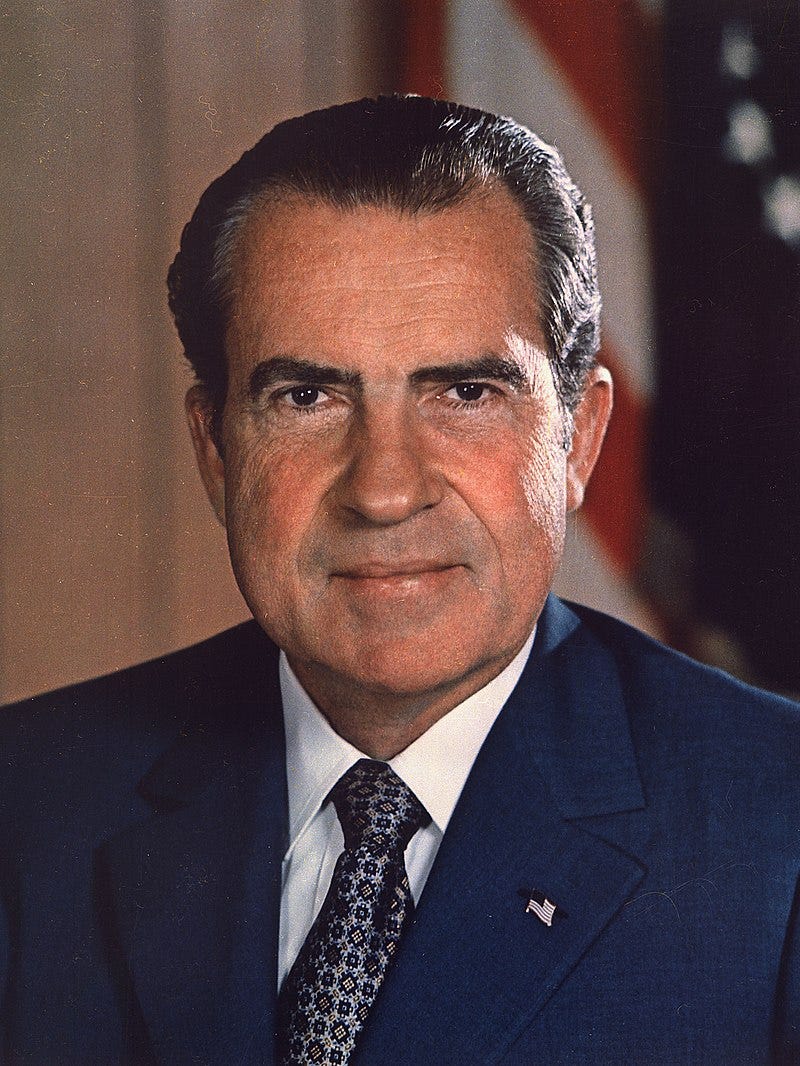
36th Vice President
Term – January 20, 1953 – January 20, 1961
Presidential Administration: Dwight Eisenhower’s Two Terms (Okay History 2021 Presidential Ranking: 5)
The Good:
Nixon envisioned a modern vice presidency where he could cultivate his foreign affairs chops and lean into his aggressiveness, which is pretty much the only reason Dwight agreed to put him on the ticket in the first place. The General wanted no part of the attack dog persona attached to him. Nixon was happy to oblige and, in the first campaign, went after President Truman’s administration for a variety of perceived incompetencies.
The Bad:
Right off the bat, after accepting the vice presidential nomination in the 1952 presidential election, Nixon was caught up in a scandal involving financial backers who paid his campaign expenses. Many in the country considered this a conflict of interest and called for Eisenhower to drop Nixon from the ticket because Dick wasn’t going to resign. This led to Nixon’s famous speech about his dog.10 Nixon also struggled to impress during his famous 1959 ‘Kitchen Debate’ with Soviet Premier Nikita Khrushchev.
Did he become president?
He sure did! Nixon would become the 39th president, and he was not okay!
Why did I rank him here?
Nixon was unrelenting when it came to becoming the president. In his mind, securing the vice president was a critical step in that direction, while having the endorsement of the popular Eisenhower as proof of his worthiness. But it was Eisenhower who put it best when asked about Nixon’s contributions as Number #2 - “If you give me a week, I might think of one.” Nixon’s behavior was rewarded, and we have forever suffered from this form of government with cruelty since.
49: Spiro Agnew
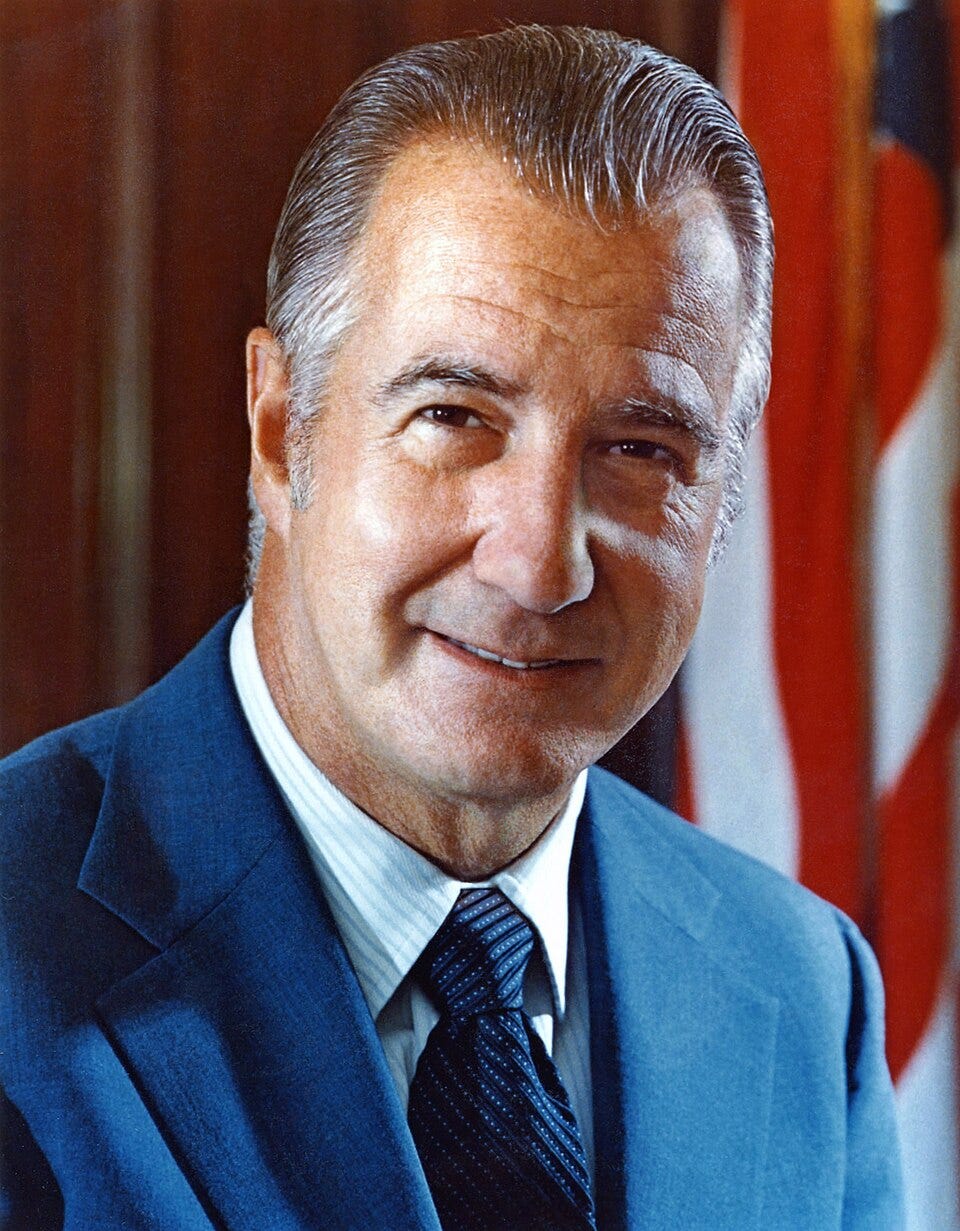
39th Vice President
Term – January 20, 1969 – October 10, 1973
Presidential Administration: Richard Nixon’s Two Terms (Okay History 2021 Presidential Ranking: 34)
The Good:
Much like his boss and the current vice president, Agnew shared the same appetite when it came to being an “attack dog.” He discovered his bombastic skills while Governor of Maryland. During the racial tension of the late 1960s, Agnew would spar with civil rights leaders over a black student activist who delivered a speech so passionate it inspired riots in the college town of Cambridge, Maryland. Agnew emerged as the “law and order” governor, who believed that activists should be thrown in jail and then the key thrown away.
The Bad:
Agnew looooooved corruption. Just as he was discovering what a jerk he could be as the chief executive of a highly ranked state, he also began to realize he could squeeze payments out of companies for government contracts. And since neither behavior prevented him from ascending to the Number 2 position in the country, he continued. It was only after being discovered and threatened by a long prison term that Agnew resigned in disgrace.
Did he become president?
No, he did not.11 But he initiated the unprecedented set of circumstances of allowing the president of the United States to assume the office, having never been elected to either position in the executive branch. Instead of not having a Vice President and allowing the succession to pass to Carl Albert,12 then the Speaker of the House, we had three vice presidents in just six months. That’s like having three couches in your bathroom – what are we doing here?
Why did I rank him here?
Spiro Agnew’s saving grace was that his demise occurred before Watergate came to light, and for the most part, he is forgotten. He landed his role because he was a first-rate dirtbag, hired by an astronomical narcissist. On top of that, he was a corrupt loser.
Okay, that’s TWO ranking essays this week. How does it feel? Feels good, doesn’t it? I feel good. Do you like the Saturday posting? I’m really hoping you do!
I’m back on Monday with the usual Maundy Monday Newsletter, so you won’t miss out on what’s happening in the week of history. Until then, have a great week.
Don’t forget – the United States and Canada in the Men’s hockey final. Do we sweep our neighbors to the north after our women won gold earlier this week?
Appreciate you all!
Okay,
Chris
I have no idea how the Washington Capitals are doing.
The idea of the Washington Capitals is apparently more important than being a fan.
Nothing screams “You are smart!” like saying “intelligence status.”
I do agree that NHL playoff hockey is high entertainment.
Who is usually too pretty to fight.
Fighting in hockey has never appealed to me.
Actual skating was the minimum requirement.
The greatest year in the history of our country.
I forgot that I did a couple of editions on presidential speeches. I need to pick that back up.
What’s scary is that Vance could resign and then run again, and no one would probably care.
Albert was a Democrat from Oklahoma who grew up in a part called Little Dixie. I swear this place is somewhere in every state.
Olympic hockey was originally structured to be played by amateurs, who were expected to adhere to genteel conduct. NHL hockey was and is commercial money-making entertainment, and therefore anathema to the Olympic spirit, based around clean, polite athletic competition.
Consequently, if players get into fights in Olympic games, they are penalized for "unsportsmanlike conduct", not "fighting", in order to ram the point home.